

Welcome to Beyond Self Improvement issue #137. Every other Wednesday (or Thursday!), I share an essay with practical ideas on finding personal freedom in an unfree world.
Dear Friend,
I sit down every two weeks to write this newsletter. Lately, something’s missing: that sense of excitement I felt when I was first discovering the things I write about.
Back then, it was as if I were being ushered into a secret world. Everything was new, fascinating, revelatory. I couldn’t wait to share my discoveries with ordinary people like me who were likely suffering too. But that was almost twenty years ago.
I know what has helped me. I know what has worked for thousands of years. Mindfulness. Meditation. Compassion. I’ve written 155 essays over five years about these topics and many others.
But the original thrill has worn off. And not just for me.
The most common response I get now is “thanks for the reminder.” But I want to do more than remind people of what they already know. I want to reveal something, shift something, help them question their perceptions. When the topics lack interest for me and newness for readers, I have to ask: Why am I doing this? Is giving back enough, even if writing about these topics leaves me underwhelmed at times?
This may be a temporary feeling or a permanent one. I don’t know yet. But right now I feel the itch to write about topics that feel more alive, engaging and energized. I want readers to feel something, not just read something they’ve heard from dozens or even hundreds of other writers.
Then, on Thanksgiving Day, I read Oliver Burkeman’s most recent newsletter, “Interest Is Everything.” He wrote that the only question that really matters when creating is: what would it genuinely interest me to write about? Not what would people find most appealing, not what the algorithm wants. What interests me. He argued that pursuing your own interests is what actually generates interesting work for others. There’s an asymmetry: trying to pursue what others might find interesting doesn’t lead you to feel interested, but pursuing what interests you does evoke interest in others.
Reading that, I realized what I was clinging to: an identity. A role. The person who teaches these things. The helper. The one who knows. Writing topics I thought I should write about, what has been most beneficial to me, rather than what’s genuinely alive in me.
I wanted to make a difference in people’s lives. So I built a following: thousands on X, thousands on Substack, thousands of monthly visitors to my website. I enjoy the comments, the appreciation, the messages about my authenticity and open heart, hearing that my writing inspires them to keep showing up and inquiring. I love meeting people online and making friends. That’s the best part. But there’s a cost I didn’t anticipate.
Writing is hard work, but completing essays has always been satisfying. Coaching has been rewarding, but not quite as satisfying as I imagined. The issue isn’t the work itself. It’s that I don’t know how much, if at all, I’ve actually helped my coaching clients or readers. Which reveals what I’m really attached to: being the helper. Making people’s lives better and helping them avoid the pain and suffering I’ve experienced.
And then there’s the transactional nature of building an audience online: liking and commenting on others’ content so they’ll engage with yours. I genuinely want to support my friends. After all, they’re facing the same dilemma as me. But I sometimes find myself reading more from a sense of obligation than pure interest. When I do have time to read, I want to sink into a book by someone who’s spent decades with the subject. The constant skimming and performing of engagement feels forced and leaves me depleted, even resentful at times, of the whole online game.
The insane competition. The millions of people vying for attention, trying to make a living online to avoid working for “the man.” Most won’t make money, fewer will pay their bills, and even fewer will replace a salary.
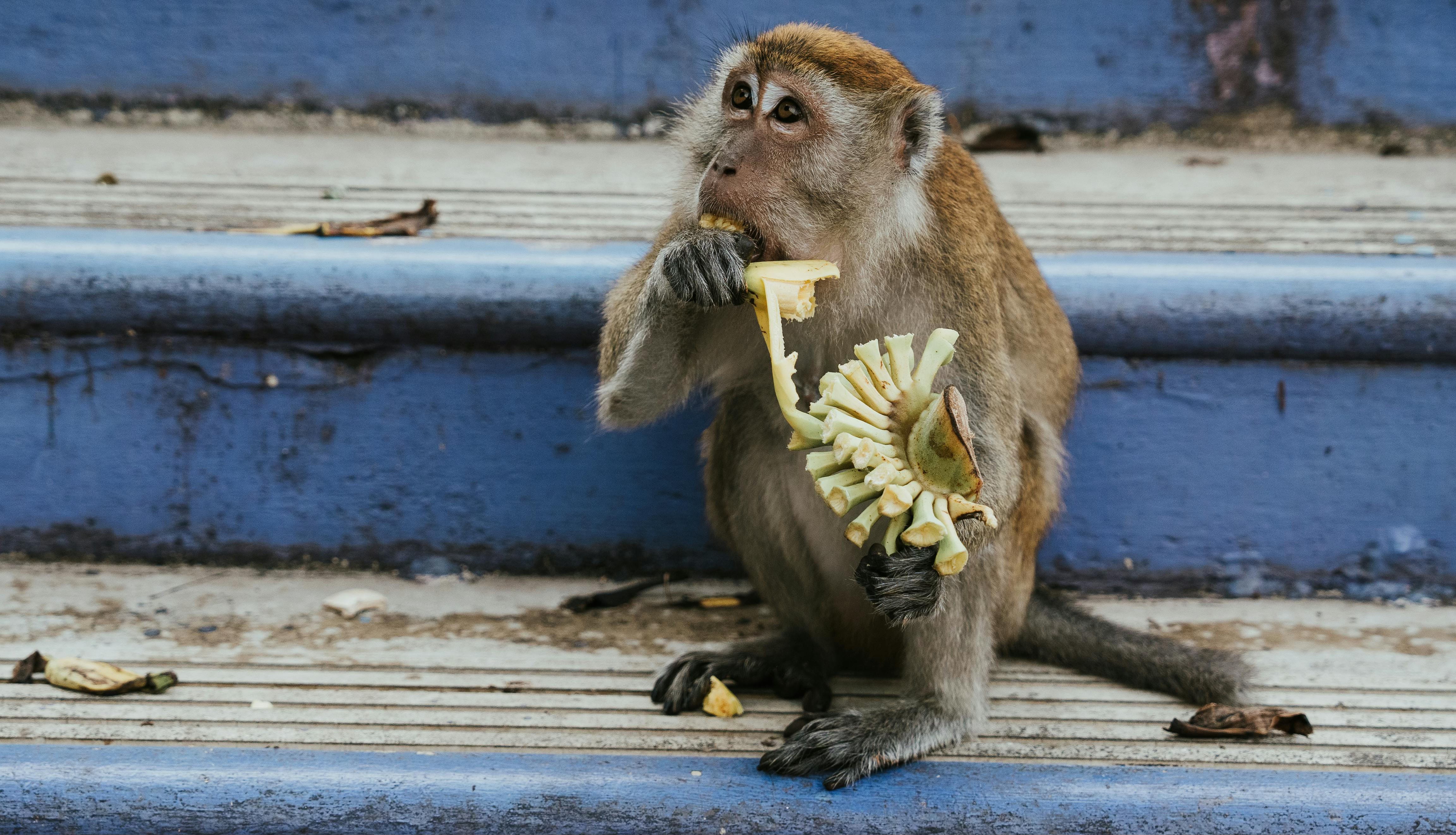
I’ve been holding the banana.
There’s an old story about how they catch monkeys in India. Hunters cut a hole in a coconut just big enough for a monkey to put its hand through. They secure the coconut to a tree and slip a banana inside. The monkey reaches in and grabs the banana. The hole is crafted so that an open hand can go in, but a fist cannot come out. All the monkey has to do to be free is let go of the banana.
But most monkeys don’t let go.
Let me be clear about something: letting go is not casual Instagram advice. It’s not some superficial technique you can dismiss in favor of “deeper work.” I recently read a book that poo-pooed letting go, treating it as shallow compared to more complex psychological processes.
Trust me: letting go is the deep work.
It’s the simplest yet most beneficial skill I know—the most straightforward advice possible, yet nothing will challenge you more. As has been said, the source of all human suffering is this fundamental sense of separateness from life and other people. And that sense of separateness comes from our clinging to a material yet illusory sense of self.
Learning to let go is a skill that remains one of the most valuable I’ve ever cultivated. And it started with a teaching that changed my life.
The meditation teacher Ajahn Sumedho once said:
“The practice of ‘letting go’ is very effective for minds obsessed by compulsive thinking: you simplify your meditation practice down to just two words – ‘letting go’ – rather than try to develop this practice and then develop that; and achieve this and go into that, and understand this, and read the Suttas, and study the Abhidhamma... and then learn Pali and Sanskrit... then the Madhyamika and the Prajña Paramita... get ordinations in the Hinayana, Mahayana, Vajrayana... write books and become a world renowned authority on Buddhism. Instead of becoming the world’s expert on Buddhism and being invited to great International Buddhist Conferences, just ‘let go, let go, let go’.
I did nothing but this for about two years – every time I tried to understand or figure things out, I’d say ‘let go, let go’ until the desire would fade out. So I’m making it very simple for you, to save you from getting caught in incredible amounts of suffering. There’s nothing more sorrowful than having to attend International Buddhist Conferences!
Some of you might have the desire to become the Buddha of the age, Maitreya, radiating love throughout the world – but instead, I suggest just being an earthworm, letting go of the desire to radiate love throughout the world. Just be an earthworm who knows only two words – ‘let go, let go, let go’. You see, ours is the Lesser Vehicle, the Hinayana, so we only have these simple, poverty-stricken practices!”
An earthworm. Not a world-renowned teacher. Not the Buddha of the age. Just an earthworm with two words.
This teaching inspired me to practice letting go with steady, persistent effort. And I’ve discovered that the practice never ends because there’s always something new to release. Always another identity to shed. Always another banana in our fist.
Even profound spiritual experiences become things we cling to.
Jack Kornfield once returned from intensive retreats, excitedly sharing all his experiences and insights with his teacher, Ajahn Chah. Ajahn Chah listened, smiled, and said: “Good. Something else to let go of.” He wasn’t dismissing the experiences. He was pointing to something more profound: can you embody this moment-by-moment, here and now, rather than collecting spiritual experiences?
Think about that. Years of practice. Profound realizations. Deep meditative states. And the teaching remains the same: let it all go.
As Ajahn Sumedho described, he spent years doing nothing but this. Every time he tried to understand or figure things out, he’d say “let go, let go” until the desire faded.
Not once. Not ten times. Jon Kabat-Zinn writes about this in Full Catastrophe Living: “We repeat this hundreds of thousands of times, millions of times, as necessary. And it will be necessary.”
Hundreds of thousands of times. Millions of times.
Because this is the practice, this is what it actually looks like.
So here’s what I’m letting go of right now:
I’ve been taking a break from Substack Notes since October, and I’ll continue to do so indefinitely. Not because I’m too busy, but because I realized I was there out of a feeling of necessity rather than a genuine longing. And because some personal matters are calling me to focus more on my own well-being right now.
I’m letting go of writing about topics that feel less alive to me, even if they “perform well.” I’m letting go of the identity of being the teacher, the helper, the one with answers.
I’m choosing to be an earthworm. To write only about what feels genuinely alive in me right now. The risk is losing subscribers, likes, and offending readers. The gain is that I’ll feel motivated, enlivened, and engaged, and that aliveness will transmit through the words.
This isn’t a one-time realization. Tomorrow, there will be something else to release. Another way I’m clinging. Another identity I’ve confused with who I actually am beneath all the conditioning.
Ajahn Chah said: “If you let go a little, you will have a little peace. If you let go a lot, you will have a lot of peace. If you let go completely, you will know complete peace and freedom.”
I haven’t let go completely. But the practice continues. Hundreds of thousands of times. Millions of times.
What are you holding onto right now? What identity, what expectation, what should? What banana is in your fist?
The hole is big enough. You can let go anytime.
If this stirs something in you—the pull to drop your own banana—share it with a friend still waiting for the right conditions to feel free. Sometimes we all need that reminder to unclench our fists and let go.
Keep letting go,
Ryan

The timing of your post is incredible. I’ve been struggling for some time now, trying to put together the pieces of the life I’m trying to build post-divorce. Married for more than 40 years, I had no clue who I even was anymore - I only knew who I didn’t want to be. So now you have revealed to me what I couldn’t understand until now - let go of the banana. Just let go.
This is the risk with commoditizing one's passions. They become obligations, something to strategize. It's why I still don't ask people to pay for my Substack. Nothing against folks doing this, but for this writer, it robs me of the freedom I find in just writing.
You've also got me wondering about the utility of novelty, as if reminders are not enough. There is so much I desire to remember against the unfathomable backdrop of what remains unknown.
Is it wise for me to churn all my gained knowledge to plant more novel seeds of knowing, considering I will never sow it all in this one brain? Surely, our most educated humans have only grazed the surface of what's knowable.
Is it wiser to stay in this narrow-but-deep space of knowing, letting that much be good enough?
I really don't know. You have me wondering. I doubt I will find an answer.